
As we’ve announced on our projects page, SFHC is currently taking an important step to expand its work in Malawi–and connect with students, researchers, and collaborators around the world.
The SFHC Farmer Research and Training Center, when complete, will serve as the hub for all SFHC activities. Large, open rooms stand ready to seat farmers attending training events. Space is set aside for a soon-to-be constructed kitchen for recipe testing, and more empty rooms will one day serve as offices, seed storage, and more. SFHC also plans to build dormitories for visitors working with SFHC.
 Visiting the center today, you’re likely to meet Burton Gama and Chance Msangu, pictured to the left in front of the center. Burton and Chance, along with the rest of SFHC’s community promotors, have played a critical role in both the center’s physical construction and the oversight of the example gardens.
The gardens demonstrate a great diversity of crops, trees and agroecological techniques. At one end of the property, you’ll find a long row of banana tree collection pits; at the other, the vegetable nursery. Beside the nursery sits the medicinal herb garden and the flower gardens. In the far corner, an excavated pit waits to be filled with water and fish. A huge field of pigeonpea stands tall in its third year. Behind it, many other legume varieties are grown, contributing to the center’s seed bank.
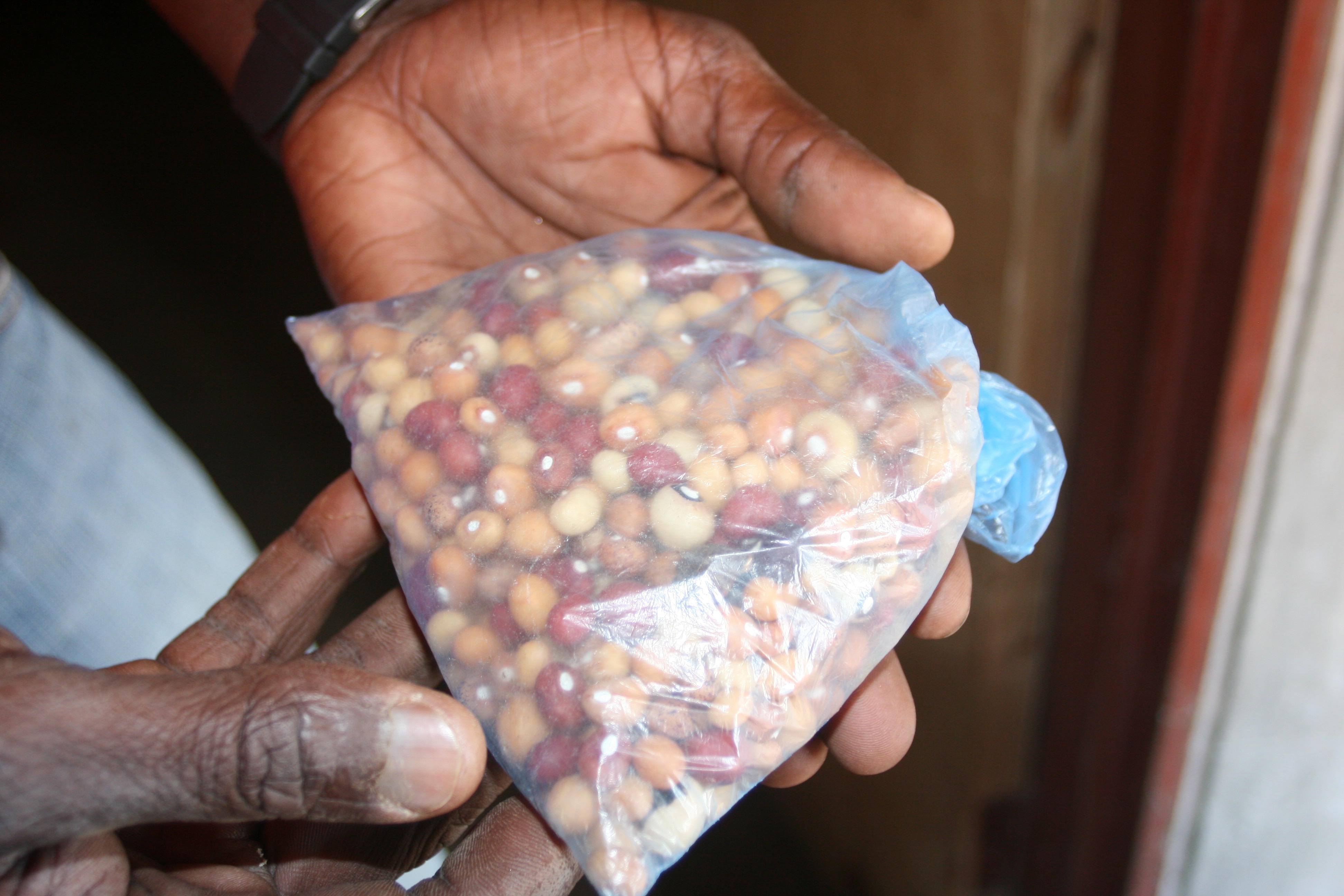
Burton Gama holds a bag of legume seeds from the seed bank.
The center’s construction thus far has been made possible through funding from the Government of Canada. However, more funding will be necessary to complete the building. Plumbing, electricity, and other carpentry work will need to be finished, and the cost of training farmers is still outstanding. We’ve laid out all our construction goals here, as well as information about how far a dollar will go toward completing construction.
If you’re interested in helping us complete this important project, find out how to donate through Friends of SFHC.
Posted: November 24, 2018 by admin Leave a Comment
Presentations at the 7th Annual Sociology of Development Conference
Stephanie Enloe, Rachel Bezner Kerr, Sidney Madsen and Noelle LaDue shared their work with SFHC this October at the 7th Annual Sociology of Development Conference at the University of Illinois at Urbana-Champaign. During a section of the conference entitled “Participatory Research for Food Security Among Smallholder Farming Households in Africa and Latin America,†Madsen and LaDue’s presentation covered the co-production of knowledge through semi-structured interviews as part of the Carasso project. Bezner Kerr and Enloe presented their work on agroecological pest management during the same session.
The conference’s stated purpose was to explore obstacles to global development from diverse perspectives. To paraphrase a slide from Madsen and LaDue’s presentation, there is room in development work to demystify science, acknowledge the co-production of knowledge, and challenge who can generate scientific knowledge. Participatory research helps balance scientific rigor with accessibility, and ensure that development projects engage with the needs of the community as they articulate them–not solely as they are interpreted by outsiders.
Posted: June 18, 2018 by admin Leave a Comment
Looking back on the Ecological Learning Collaboratory
New from the Cornell Chronicle, a story about the Ecological Learning Collaboratory we discussed in our previous post. Read the Chronicle article here!
The article does a wonderful job providing additional details on the workshop, its goals, and its future. SFHC looks forward to its continued partnership with workshop participants from Tanzania and India, and we are delighted that the gathering attracted interest from both Ritsumeikan University and the University of Gastronomic Sciences in Pollenzo, Italy. We hope that this is the first step in a dialogue across institutions, organizations, and hemispheres.
Worth highlighting is a quote from SFHC’s own Laifolo Dakishoni (excerpted from the article above):
“Whatever ideas are generated here, we will continue discussing…This will be an evolution. We’ll get some ideas, we’ll test them under our own conditions, and if it doesn’t work we’ll go back to the people where it is working … and get their advice.â€
We look forward to keeping you up-to-date in this ongoing experiment in knowledge production and problem-solving.
Posted: June 9, 2018 by admin Leave a Comment
SFHC and the Ecological Learning Collaboratory
Supported by the Mario Einaudi Center for International Studies, the Ecological Learning Collaboratory (ELC) launched last week at Cornell University. The ELC was born out of several international organizations’ shared interest in supporting healthy communities, food sovereignty, fair trade and control of production, and ecologically sustainable solutions. Organized by Cornell faculty members Neema Kudva, Rachel Bezner Kerr, and Stacey Langwick, international partners from India, Malawi, and Tanzania participated in an intensive workshop from May 29th through June 2nd. Agroecology, wildlife, health, social justice, value-addition and engaged knowledge were just some of the topics covered. Speakers from many different fields presented their work to the group, and participants took trips to health clinics, farms, festivals and markets.
The SFHC team had the honor of hosting a dinner for over 40 guests, including workshop participants, donors, students and interested members of the Ithaca, NY community. They shared videos of project trainings and spoke on the nature of their work in Malawi, emphasizing the ways SFHC engages with complex social issues while supporting sustainable agricultural landscapes.
The workshop was a terrific opportunity for collaboration, knowledge exchange and spreading awareness. To read more about the ELC and its future, visit the project’s web page here.
Posted: May 18, 2018 by admin Leave a Comment
New Publication from SFHC Team Members
SFHC affiliates and team members (Rachel Bezner Kerr, Hanson Nyantakyi-Frimpong, Laifolo Dakishoni, Esther Lupafya, Lizzie Shumba, Isaac Luginaah and Sieglinde S. Snapp) have just released a new paper on the political ecology of climate change in Renewable Agriculture and Food Systems.
The paper, entitled “Knowledge politics in participatory climate change adaptation research on agroecology in Malawi,” is available online for free reading here.
Check out the abstract below:
“Climate change is projected to have severe implications for smallholder agriculture in Africa, with increased temperatures, increased drought and flooding occurrence, and increased rainfall variability. Given these projections, there is a need to identify effective strategies to help rural communities adapt to climatic risks. Yet, relatively little research has examined the politics and social dynamics around knowledge and sources of information about climate-change adaptation with smallholder farming communities. This paper uses a political ecology approach to historically situate rural people’s experiences with a changing climate. Using the concept of the co-production of knowledge, we examine how Malawian smallholder farmers learn, perceive, share and apply knowledge about a changing climate, and what sources they draw on for agroecological methods in this context. As well, we pay particular attention to agricultural knowledge flows within and between households. We ask two main questions: Whose knowledge counts in relation to climate-change adaptation? What are the political, social and environmental implications of these knowledge dynamics? We draw upon a long-term action research project on climate-change adaptation that involved focus groups, interviews, observations, surveys, and participatory agroecology experiments with 425 farmers. Our findings are consistent with other studies, which found that agricultural knowledge sources were shaped by gender and other social inequalities, with women more reliant on informal networks than men. Farmers initially ranked extension services as important sources of knowledge about farming and climate change. After farmers carried out participatory agroecological research, they ranked their own observation and informal farmer networks as more important sources of knowledge. Contradictory ideas about climate-change adaptation, linked to various positions of power, gaps of knowledge and social inequalities make it challenging for farmers to know how to act despite observing changes in rainfall. Participatory agroecological approaches influenced adaptation strategies used by smallholder farmers in Malawi, but most still maintained the dominant narrative about climate-change causes, which focused on local deforestation by rural communities. Smallholder farmers in Malawi are responsible for <1% of global greenhouse gas emissions, yet our results show that the farmers often blame their own rural communities for changes in deforestation and rainfall patterns. Researchers need to consider differences knowledge and power between scientists and farmers and the contradictory narratives at work in communities to foster long-term change.”
Posted: February 21, 2018 by admin Leave a Comment
Progress at the Farmer Research and Training Center
We are pleased to announce some exciting new developments at the SFHC Farmer Research and Training Center! A new pig and poultry enclosure, pictured above, was made possible through funding received from Friends of SFHC. We extend our deepest gratitude to our donors, and invite anyone interested in following the center’s development to check out our construction page here.
Pictured below, you’ll see we also have a new water tank at the center built by farmers.
Once again, a big thank you to our donors for making projects like these possible. If you’re interested in contributing, you can find more information here. We hope to have many more exciting developments to share with you as construction continues.
Last Updated: March 5, 2023 by admin 1 Comment
Our “Farming for Change” Curriculum is Now Available
We are pleased to announce that our participatory, integrated curriculum is now available for download for non-profit use! “Farming for Change: A Participatory Teaching Guide on Agroecology, Climate Change, Nutrition and Social Equity” is a training manual written by a team of collaborating farmers, scientists, and staff from development organizations in Malawi and Tanzania. You can read more about the curriculum’s development, goals, and progress here.
Before being granted access to the download page, we ask that you complete a short questionnaire telling us why you’re interested in the curriculum. This not only helps us learn about who is using the material and to what end, but it also opens up the opportunity for dialogue between all of us who are interested in participatory, agroecological approaches to building healthy, sustainable communities.
The curriculum is currently available in English, Chichewa, Swahili, and Tumbuka (for non-profit use only). The questionnaire here will lead you to the download page.
Last Updated: January 16, 2018 by admin Leave a Comment
Building the SFHC Farmer Research and Training Center
As we’ve announced on our projects page, SFHC is currently taking an important step to expand its work in Malawi–and connect with students, researchers, and collaborators around the world.
The SFHC Farmer Research and Training Center, when complete, will serve as the hub for all SFHC activities. Large, open rooms stand ready to seat farmers attending training events. Space is set aside for a soon-to-be constructed kitchen for recipe testing, and more empty rooms will one day serve as offices, seed storage, and more. SFHC also plans to build dormitories for visitors working with SFHC.
The gardens demonstrate a great diversity of crops, trees and agroecological techniques. At one end of the property, you’ll find a long row of banana tree collection pits; at the other, the vegetable nursery. Beside the nursery sits the medicinal herb garden and the flower gardens. In the far corner, an excavated pit waits to be filled with water and fish. A huge field of pigeonpea stands tall in its third year. Behind it, many other legume varieties are grown, contributing to the center’s seed bank.
Burton Gama holds a bag of legume seeds from the seed bank.
The center’s construction thus far has been made possible through funding from the Government of Canada. However, more funding will be necessary to complete the building. Plumbing, electricity, and other carpentry work will need to be finished, and the cost of training farmers is still outstanding. We’ve laid out all our construction goals here, as well as information about how far a dollar will go toward completing construction.
If you’re interested in helping us complete this important project, find out how to donate through Friends of SFHC.
Last Updated: January 16, 2018 by admin Leave a Comment
SFHC in the USA, Filming with Raj Patel
SFHC team members Esther Lupafya and Anita Chitaya have arrived in the United States, marking the beginning of a month-long journey across the nation. Working with Raj Patel and Generation Food, they will make stops to share their experience with food systems, social issues, and climate change consequences–and much more. Their trip will put them in touch with a myriad of audiences, spreading awareness and telling their stories along the way.
Today’s stop–Washington, D.C.!
You can follow Raj Patel on Twitter at @_RajPatel, and read more about Generation Food’s mission to share food system stories from around the globe here.
Photo Credit @_RajPatel— From left to right: Anita Chitaya, Esther Lupafya and Raj Patel
Last Updated: June 29, 2017 by rachel Leave a Comment
SFHC Ecological Garden is taking shape
SFHC members spent the day planting legumes, fruit trees and other crops in the new SFHC Centre garden today. They are building a living fence to keep out livestock and are building contour ridges to reduce soil erosion. They have received support from Seeds Knowledge Initiative, a like-minded organization based in South Africa that is helping SFHC build alliances across the region focused on food sovereignty, agroecology and equity. John Nzira from Ukuvuna in South Africa has provided training and support for permaculture design to be integrated into the SFHC Centre.
Pressings Moyo, Esther Lupafya, Esther Maona, Laifolo Dakishoni and other SFHC members build contour ridges and plant crops as part of their new permaculture-designed garden at the SFHC Centre.
Posted: August 6, 2016 by Catherine Hickey Leave a Comment
Seed Sovereignty and Climate Adaptation in Malawi
Timothy Wise, Director of the Research and Policy Program at the Global Development and Environment Institute at Tufts University, recently visited the MAFFA project site in Lobi. After his visit, Wise published an article with Food Tank highlighting our work while discussing the importance of seed sovereignty in Malawi and in Africa more broadly.
Navigation